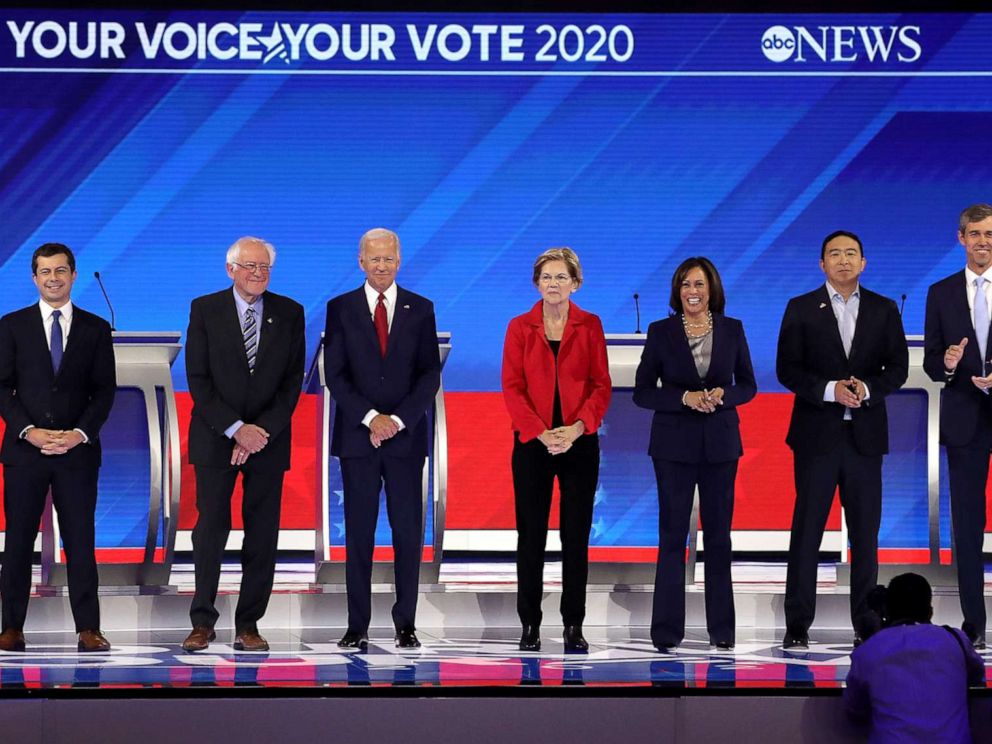
When America was founded, a system of checks and balances were implemented to ensure no one branch held too much control. The scope of executive power has increasingly become more complicated due to President Trump's actions in office. After responding to a survey about Trump and the power he wields, 2020 presidential candidates argued the need to implement stricter legal limits in the future. These new laws ranged from requiring presidents to disclose their tax returns to appointing close relatives to White House positions.
In the survey, 15 Democrats, all in the top polling tier, and 3 Republicans provided their stance on eleven essential executive powers and the actions they would take if in office. Most of the candidates are determined to bring reform to the presidency, but Jack Goldsmith, a Harvard law professor and former senior Justice Department official in the George W. Bush administration believes they may have second thoughts. Goldsmith claims, "The next Democratic President will happily accept new rules on tax releases, but will have a harder time accepting constraints on security clearances and emergency or war powers".
In 2007, Joe Biden provided a restrictive view of when presidents may direct military intervention, stating, “The Constitution is clear: Except in response to an attack or the imminent threat of attack, only Congress may authorize war and the use of force.” Nevertheless, in the survey conducted this past year, Biden described it "well established" that Presidents may launch limited strikes “without prior congressional approval when those operations serve important U.S. interests.” The bombing campaign in Libya in 2011 authorized by the Obama administration clearly violated a limit on executive war-making powers that both Obama and Biden said they would abide with during a 2007 candidate survey.
Within the 2019 survey, candidates were split on ideas such as curtailing future presidents' freedom to invoke emergency powers and to choose acting agency heads when temporarily filling vacancies. On the other hand, they collectively agreed in rejecting the view of Trump's legal team in which obstruction of justice laws do not apply to presidents who exploit their authority to interfere with investigations. While it is difficult to find common ground among all of the candidates within each issue, they share the desire to restrain presidential power in the future. Nevertheless, it is vital to understand that many candidates strategically create their campaign message to appeal to the people, but do not always follow their own ideals.
1. In 2007, President Obama and Vice President Biden firmly believed Congress had the authority to declare war. Nevertheless, their bombing campaign in Libya violated a limit on executive order and conflicted with their statements. Do you believe the presidential candidates will still abide by their decisions to restrict executive order if they sit in office in 2020? Why or why not?
2. There are many new laws the presidential candidates suggested since Trump has been in office. These laws will require presidents to disclose their tax returns and to divest from significant assets; bar them from appointing close relatives to White House positions; and constrain their abilities to award security clearances and to fire special prosecutors investigating their administration, among other potential reforms. Explain which law is most significant to curbing presidential power?
3. Explore one of the presidential candidates from the survey. What actions would they take if they became president?

1. Even if people claim to believe a specific idea on their campaign, there is no promise that anything will actually be done to follow that ideal once in office. Part of a president's job is damage control, so if there was some sort of national security crisis, there is no telling what any candidate may do to protect the American people even if it means establishing executive orders. In addition, some executive orders have been beneficial and don't have to do with war, so they'll probably still issue them especially if Congress is still partially controlled by Republicans and if they want to get anything done.
ReplyDelete3. Joe Biden states that few actions that he would take once he becomes the president. If it was necessary, he would declare war without congress' approval. Also, if a citizen of the US engaged in violence within the US border, they would be prosecuted by our law enforcement and civilian criminal justice system. He also said that he would restore a strong Department of Justice system guided that of the principle which states that no one is above the law.
ReplyDelete1. I do not believe that presidential candidates will restrict executive orders if elected. With the polarization in the Senate, it is nearly impossible to have laws passed. There are times when whoever is elected will need to do something and instead of trying to get it through Congress, it is easier and more efficient to make an executive order. While they may say that they will limit the use of executive orders, there will come a point in every presidency where it is nearly impossible to get anything done or some kind of crisis that will force the president to use an executive order.
ReplyDeleteThis comment has been removed by the author.
ReplyDelete2. I definitely think that the law constraining the president's ability to award security clearances and to fire special prosecutors investigating their administration is the most significant to curbing presidential power. If an individual president is able to fire anyone looking into his administration, then there are serious problems with the separation of powers. The point of having three separate branches of government is so that they are each held accountable by the others. This law would decrease an individual's power because they would not be able to hide corruption as easily.
Delete1. It is impossible for any candidate to try to say a number or restrict the number of executive orders because of the unknown. Executive orders became very handy and beneficially in situations when time is an issue, but the polarization of congress could never lead to a resolution in time. No one is able to predict what they would really do in the Presidential seat until they finally do for themselves and feel it for themselves.
ReplyDelete#1 Most presidents in recent history have dealt with the harsh realities of working with Congress post-honeymoon period. Whether or not the president will have to resort to extensive executive orders will really depend on what degree of control his party will have over each house. In an era of increased polarization, sometimes the president may feel that the only way to break through the gridlock is by decisive action. It should be noted that ever since the Ford Administration, each president's have only issued roughly 150 executive orders per term. The fact that this figure has remained relatively consistent suggests that presidents have not gone out of the way to endlessly increase their authority by circumventing Congress.
ReplyDeleteI researched Warren (Pocahontas) and she acknowledges the needs of our fellow Americans and believes that in order to increase the happiness of regular workers, there needs to be an increase in the minimum wage. Up to $15. Which doesn't sound too bad, but what about the economy!
ReplyDelete