Sunday, October 27, 2019

Hong Kong Human Rights and Democracy act is passed in the House of Representatives

https://www.cnn.com/2019/10/15/politics/hong-kong-house-vote/index.html


The Hong Kong extradition bill which sparked an immense protest during June of this year essentially
allowing China to extradite any criminal that is within Hong Kong territory. Pro-democracy activists in Hong
Kong have been consistently fighting for their democracy through escalating protests. This issue regarding
foreign policy has recently gained traction from multiple nations across the world, including the United States.
Throughout the course of the week, the United States House of Representatives have passed a “bicameral,
bipartisan, Hong Kong Human rights and democracy act”. The legislation would allow the United States to
annually review the Hong Kong autonomy while simultaneously allowing the president to pose sanctions and
travel restrictions on those who have violated said autonomy or the Sino-British Joint Declaration through the use of torture, forced confession, and arbitrary detention. Although the legislation has passed the House of Representatives, the Senate version of the legislation is still awaiting for the floor vote which may alter the act. President Trump must also remain silent regarding the issue as the high tension trade talks between the Chinese and the United States are currently in progress and if any bias towards Hong Kong is explicitly shown, the economy may suffer as a consequence.

1. If the bill does pass both the house and the senate, how do you think Trump will react? How about the reaction from China?
2. Do you believe the US should expand our foreign policy or should we hold ourselves back from conflicting interests from different nations? Why or why not? How would our interference with foreign interests affect the nation?
3. How does the bicameral decision to pass the Hong Kong Democracy Act reflect our nation's interests and politics?

Friday, October 18, 2019

Faithless Electors’ Could Tip the 2020 Election. Will the Supreme Court Stop Them?


https://www.nytimes.com/2019/10/14/us/politics/supreme-court-faithless-electors-2020.html

In the 2016 Presidential Election, the electoral vote was expected to be 306 for Donald J. Trump and 232 for  Hilary Clinton. However, 10 electors “went rouge”, voting for canidates other than the one their partiy selected.  A swing by that number of electors would have been enough to change the outcomes in five of the previous 58 presidential election, raising concerns for many Americans because it reveals the shortcomings of the electoral system in representing the general will. As a result, a petition was introduced to the Supreme Court, asking the justices to decide whether “faithless electors” were free to disregard pledges they made to vote for their own parties’ candidates. The petion also asked the courts to come to a decision quickly because waiting until the next election cycle would be too controversial for the courts, especially during a time when politics are especially polarized. The main question the Court would decide upon is when or not the constitution permits restrictions on who electors can vote for, and wether or not states are allowed to interfere once voting begins, tby removing an elector, directing the other electors to disregard the removed elector’s vote or by appointing a new elector to cast a replacement vote.”

Questions:
1) What are the dissenting and concurring opinions in this case?
2) Why would it be problematic for the Supreme Court to make a ruling on this case during a presidential election? (Political thicket)
3) Does the constitustion favor elector independence? Why or why not?

Monday, October 14, 2019

Trump Involves the Environmental Protection Agency In His Fight Against SF’s Homelessness


Donald Trump came back to the Capitol from a fundraising trip to San Francisco with yet another enemy. He called San Francisco and Los Angeles out for their large homeless populations and claimed that they were violating permits as well as regulations set by the EPA. Members of the EPA’s staff visited California in early September, to see whether or not San Francisco was in fact violating any regulations put into place. Andrew Wheeler, the Administrator of the EPA, claims that the agency has no jurisdiction on homelessness, but they will take a look at the water waste systems of the city. President Donald Trump is using the power of the federal bureaucracy to work on limiting the power of the people, specifically in this case the states. In addition to his crackdown on homelessness, he also ordered the EPA to break its agreement with California to allow the state to create its own vehicle emission regulations. He believes that this will allow cars to become more affordable for the people, but it also follows his goal to get rid of as much environmental protection policy as possible. San Francisco’s mayor, London Breed, responded to Trump’s tweets by asking the federal government how they were going to support efforts to reduce homelessness. She explains that San Francisco is dedicated to its work regarding homelessness, and is ready to add new shelters, as well as invest $600 million for affordable housing.

1) How does President Trump's attack on San Francisco look foolish after Mayor Breed's response? Would this cause a president to reconsider and work with San Francisco to reach their goals? How does Trump's reaction differ?

2) Agencies within the bureaucracy have bureaucratic discretion, which allows them to decided if they would like to act on an issue or not. President Trump on the other hand also has the ability to direct them to do something, but that doesn't mean the bureaucrats have to follow those orders. How does the EPA react to the issue? Do they follow Trump's orders? Why do you think they executed the situation the way they did?

3) How do you think the bureaucracy should be used? Do you believe that Trump is overstepping his boundaries and giving to much power to the bureaucracy?


Tuesday, October 8, 2019

2020 Presidential Candidates Reinforce Restricting Presidential Power after Trump

https://www.nytimes.com/2019/09/10/us/politics/executive-power-survey-2020.html


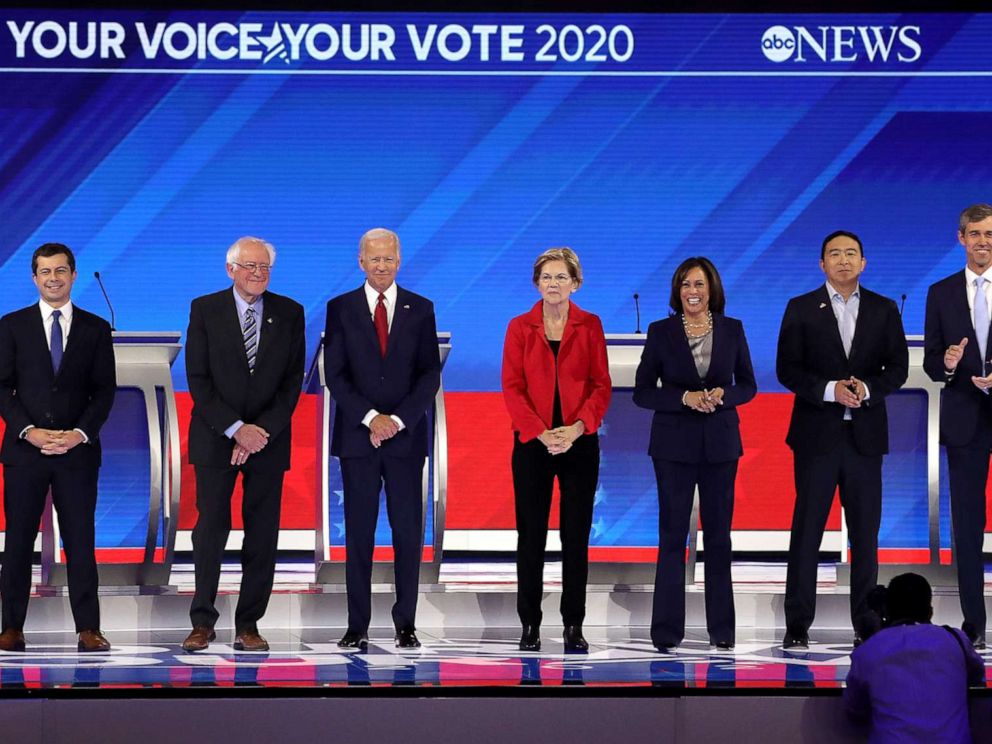
PHOTO: Democratic presidential candidates appear on stage before the start of the Democratic Presidential Debate at Texas Southern Universitys Health and PE Center on Sept. 12, 2019, in Houston.

When America was founded, a system of checks and balances were implemented to ensure no one branch held too much control. The scope of executive power has increasingly become more complicated due to President Trump's actions in office. After responding to a survey about Trump and the power he wields, 2020 presidential candidates argued the need to implement stricter legal limits in the future. These new laws ranged from requiring presidents to disclose their tax returns to appointing close relatives to White House positions.

In the survey, 15 Democrats, all in the top polling tier, and 3 Republicans provided their stance on eleven essential executive powers and the actions they would take if in office. Most of the candidates are determined to bring reform to the presidency, but Jack Goldsmith, a Harvard law professor and former senior Justice Department official in the George W. Bush administration believes they may have second thoughts. Goldsmith claims, "The next Democratic President will happily accept new rules on tax releases, but will have a harder time accepting constraints on security clearances and emergency or war powers". 

In 2007, Joe Biden provided a restrictive view of when presidents may direct military intervention, stating, “The Constitution is clear: Except in response to an attack or the imminent threat of attack, only Congress may authorize war and the use of force.” Nevertheless, in the survey conducted this past year, Biden described it "well established" that Presidents may launch limited strikes “without prior congressional approval when those operations serve important U.S. interests.” The bombing campaign in Libya in 2011 authorized by the Obama administration clearly violated a limit on executive war-making powers that both Obama and Biden said they would abide with during a 2007 candidate survey.

Within the 2019 survey, candidates were split on ideas such as curtailing future presidents' freedom to invoke emergency powers and to choose acting agency heads when temporarily filling vacancies. On the other hand, they collectively agreed in rejecting the view of Trump's legal team in which obstruction of justice laws do not apply to presidents who exploit their authority to interfere with investigations. While it is difficult to find common ground among all of the candidates within each issue, they share the desire to restrain presidential power in the future. Nevertheless, it is vital to understand that many candidates strategically create their campaign message to appeal to the people, but do not always follow their own ideals.

1. In 2007, President Obama and Vice President Biden firmly believed Congress had the authority to declare war. Nevertheless, their bombing campaign in Libya violated a limit on executive order and conflicted with their statements. Do you believe the presidential candidates will still abide by their decisions to restrict executive order if they sit in office in 2020? Why or why not?

2. There are many new laws the presidential candidates suggested since Trump has been in office.  These laws will require presidents to disclose their tax returns and to divest from significant assets; bar them from appointing close relatives to White House positions; and constrain their abilities to award security clearances and to fire special prosecutors investigating their administration, among other potential reforms. Explain which law is most significant to curbing presidential power?

3. Explore one of the presidential candidates from the survey. What actions would they take if they became president?